Showing posts with label presentation of work. Show all posts

Thursday, November 29, 2012

Postcards Happy


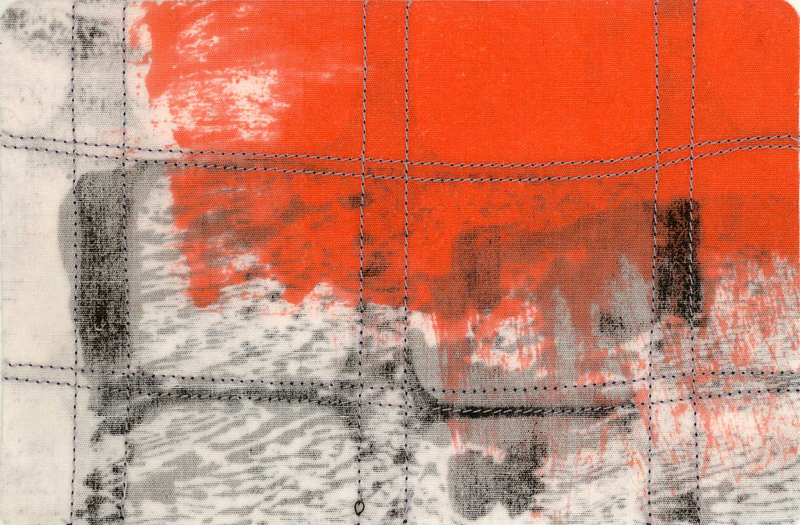
For as long as I can remember, I've wanted to make postcards out of the fabric I print and paint, but I wasn't sure how to do it. Naturally, I was very interested in a Kickstarter campaign earlier this year that offered DIY adhesive postcard labels, called Postick.

Postick was invented by a woman in South Africa. She sent homemade hand written thank you cards to all of her 478 Kickstarter investors (which I loved receiving), and now that I have my packages of Postick, I'm finally going to be able to make my fabric postcards.

Shown above and below, is my thank you postcard to her.

I'm hoping that Postick will be available for purchase in the US sometime soon so I can purchase more.


Thursday, July 26, 2012

Thank You!


I would like to thank the Massachusetts College of Art and Design Alumni Office for using a detail of The Fence As Lace #1 as the header for this week's Alumni newsletter.

Thursday, February 16, 2012

Hanging Work

While at the Paper Show that recently closed at Fountain Street Fine Art in Framingham, MA, I saw a really smart way to hang work away from the wall, that maximizes shadows and is really quilt simple. It gives me some ideas about how to hang some of my work that's made with stiffened fabric with holes cut in it.

I apologize for not remembering who the artist is who used this hanging system, but whoever you are, thank you for the inspiration!

Wednesday, December 28, 2011

Seasonal Fences Presentation Options

In 2011, I created a four part series, Seasonal Fences, which are abstractions of different colors of fences in contrast to the landscape during different seasons. They can be shown as a group of five of the same season or as a group of four that shows all four seasons with the same color of fence in the landscape. Here are nine different grouping options, besides hanging them individually. My hope is that these different options will be of interest to curators for an exhibit or art consultants for purchase in an office or home. The size of each individual piece in this series is 22" x 10" x 1", and they are all mixed media cradled board.

Seasonal Fences - Four Seasons 1 (above, with silver fences)

Seasonal Fences - Four Seasons 2 (white/off white fences)

Seasonal Fences - Four Seasons 3 (orange fences)

Seasonal Fences - Four Seasons 4 (green fences)

Seasonal Fences - Four Seasons 5 (brown fences)


Tuesday, October 18, 2011

Outdoor Installation: New Photos and More Info

I hired an architectural photographer to take pictures of Fence/Curtain 1.0, my outdoor art installation at the ConstellationCenter in Cambridge, MA. Many thanks goes to Clements and Howcroft for their amazing work!

Please visit my website to read my artist's statement and also to see the images larger.


There are five other artists who have installed work on the site. They are:

Carolina Aragón: Ether

Ross Miller: Foreshadowing Light

Gary Orlinsky: Proscenium

SIPLA + NEWSAM Studio: Score

John Tagiuri: Reclining Nudes 1-6

Visit the ConstellationCenter website to read information about them and to also images of their work.

Thursday, October 6, 2011

Photography

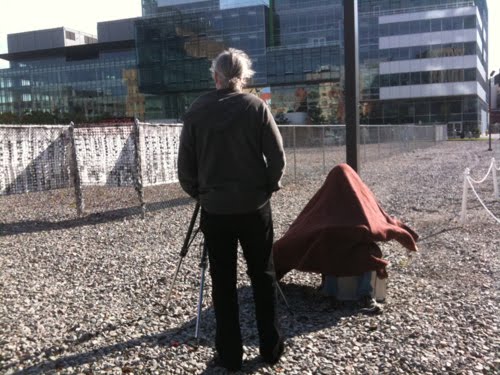
Good photography is incredibly important in the art world, so I took a friend's advice and hired a professional for my outdoor art installation. Yesterday morning, when the sun came out after having had a few days of heavy rain, I met architectural photographers Stewart Clements and Will Howcroft from Clements and Howcroft on site in Cambridge, MA.

They shot my piece from many angles, both at a distance and close up, and from the front and also the back. Will was on the camera and Stewart on a laptop (shown here under the brown blanket so he could block the sun's reflection from his laptop screen). They coordinated color, contrast, line, and etc between my piece and the buildings nearby. I really liked working with them and I look forward to seeing the images in the next week or so.

When the images are ready, I'll pick the ones I want to use, and then I'll replace the not so great images I took that are on my website with theirs, and I'll also post some here on my blog.

Thanks, and an apology, also go to my dear husband for the brown blanket that he keeps putting in the back of the car, even though I keep complaining about how much room it is taking up. It was put to good use during the photo shoot.

Wednesday, August 17, 2011

deCordova Museum Corporate Art Loan Program

All 12 pieces in my Traces of Past Fences Series are now included in the deCordova Museum of Art Corporate Art Loan Program. There's a page about my work here on their website. I'm proud to be among the very talented artists who are participating in this program.

They also have a blog, and there's a post about me.

If you're not familiar with this program, here is the description, as written on their website:

"Art Loan

Create an invigorating environment for clients and employees with the help of deCordova’s Corporate Program. The Art Loan Option is an exciting Membership benefit which provides businesses the opportunity to exhibit artwork of both established and emerging contemporary New England artists directly in Corporate Member offices. Corporate Program staff work closely with Corporate Members to assess artwork needs, determine appropriate exhibition locations, and make curatorial recommendations for exhibition content. The original artworks available for loan are from deCordova’s extensive Permanent Collection and are augmented by the artwork of Lending Artists. Upon annual renewal of a Corporate Membership, exhibitions are rotated to ensure a continuously stimulating and educational atmosphere."

Artists interested possibly participating can read more about it here.

Sunday, June 13, 2010

Image Advice After Jurying a Show


I juried an art quilt show with another artist this past week. It was my second time jurying a show, and I will be jurying a third later this summer.

It's a really interesting experience being a juror instead of an entrant. I'll gather my thoughts about it for a possible post after I jury the next show, but I did want to post about image quality now.

Here are some words of advice:

- Don't submit blurry pictures.

- If your art is square or rectangle, do your very best to make sure it appears that way, or as close as possible, in the picture. When the image is presented as a trapezoid, it's hard for the juror to know if it's really a square or a rectangle, or if it is in fact a trapezoid.

- Shoot your images on a blank wall, not in front of a window, or on a patterned wall, or in a room with furniture, that might be confused as part of the art.

- Try to have your color to be as accurate as possible.

- Washed out photos should be avoided.

- If you can afford to get professional photographs of your work, do.

Sunday, May 16, 2010

More Portfolio Reviews


I participated in more portfolio reviews yesterday. This time they were sponsored by an art marketing class I took two years ago. When I did them on May 2nd, they were through a different organization.

This time, my portfolio reviewers consisted of one college gallery director, one in-house corporate art consultant, and one art consultant who works for a company that places art in businesses and other institutions. When I registered, I specifically asked to meet with the two art consultants because I wanted more info about what they may be looking for. Meeting with them was research for me, because I was already planning on sending my portfolio to a group of art consultants ASAP.

Like my portfolio review two weeks ago, once again I brought nine pieces of new work with me. Seven are mounted on boards (one of my Slivers of Fences series, two of my Patterns in Fences series, two from Traces of Past Fences, and two Fence Details), and two pieces created with stiffened fabric (one Weathered Fences series and one Walls from Fences series). I wanted to show larger and smaller work in slightly different mediums. And, I also brought my portfolio which I presented on an ipad.

The reviewers got to touch the Weathered Fences piece, look through the holes, and see that they're two sided. Two were really interested in them shown on the wall with shadows. One reviewer talked about possibly exhibiting them behind plexiglass to protect them from being touched. It didn't seem to be a problem that they are large and the plexi would add to the cost.

We discussed my possibly making smaller Walls from Fences pieces that could framed or mounted behind glass. The piece I brought is 46" x 24", and I think half or a quarter of the size would work very well presented that way.

They really responded nicely to my work on boards. I was told that my work is mature and that my craftsmanship was excellent, which was a nice compliment. I was glad that the texture and line from the stitching on these pieces was appreciated. One art consultant was interested in showing her clients a grouping of my 10" square Patterns in Fences series, and she especially loved the 18" square size of my Slivers of Fences series. She said 18"+ was a good corporate size for her clients, and that I should make more work on boards that are 18" or even slightly larger.

Besides showing actual work, I also showed them my portfolio via my ipad. It's easy to use and look at because the images are crystal clear, and it's really easy to flip from page to page at your convenience just by moving your finger across the screen. This time I added installation shots of my work mounted on boards, showing them in groups on exhibit, to show how they look on the wall. That went over very well. I didn't have these shots two weeks ago, and was asked to see them a few times, so I did update my portfolio for this review. I'm glad I did.

I also showed pictures of my installation in the Studios Without Walls show (that's on exhibit now), pictures of the new installation in my back yard. One reviewer was very interested in the work installed outside on the tree (more 3D), and one was more interested in the flat piece in my back yard, which is more screen-like (or 2D).

Both art consultants asked about how my work will age over time, in terms of fading or falling apart. The paints I use are acrylic based and don't fade, and the printed/painted/stitched fabric is attached to the boards with matt medium which is archival, so there's no worry about them in the future.

My next step is to send each of my reviewers a thank-you note, and to send my portfolio to all three, one of whom wanted materials immediately so I'll be emailing that to her later today.

Tuesday, May 4, 2010

New Photos from Studios Without Walls


At the Studios Without Walls Opening on Saturday, I had the pleasure of meeting Adam Weiss, a Digital Media Journalist.


I am usually shy about this, but I asked him if he could take some pictures of my installation because he had a wonderful digital camera. My cameras are my phone, and also a point and shoot camera, which do the job but aren't great.


You can see more pictures of the installation, both Adam's pictures and mine, on my website. The pictures shown in this post are all by Adam Weiss


Studios Without Walls is on exhibit in Brookline/Boston, Massachusetts through June 13th. There are over a dozen sculptures installed along the Muddy River, in Riverway Park, between the Longwood T stop and Park Drive. The exhibition is visible during daylight hours.


Sunday, May 2, 2010

Portfolio Review


This morning I participated in a another portfolio review that was hosted by a Boston area Art Association, after participating in them previously in 2009 and in 2008.

For anyone who doesn't know what a Portfolio Review is: "The Portfolio Review is an opportunity to receive serious one-on-one critiques (each lasting twenty minutes) from gallery owners, museum curators, and influential experts in the art field."

This year my portfolio reviewers consisted of one curator who recently worked at a well known and respected Rhode Island Art Museum, a curator/educator/artist from a university in the southern USA, and the third is the gallery manager of a well known and respected Boston art gallery that was established in the 1970's.

This year I brought with me nine pieces of new work. Seven are mounted on boards (one of my Slivers of Fences series, two of my Patterns in Fences series, two from Traces of Past Fences, and two Fence Details), and two pieces created with stiffened fabric (one Weathered Fences series and one Walls from Fences series). I wanted to show larger work and smaller work, in (ever so) slightly different mediums. And, I also brought my portfolio which I presented on an ipad.

I found that presenting my work on the ipad was easy to use and look at because it's really easy to flip from page to page at your convenience just by moving your finger across the screen. Definitely worth the investment! (Last year I had a printed portfolio, but I think the digital quality looks much better than what I get from my printer, and there's no ink or paper expense when using an ipad.)

Last year I mentioned here on this blog that "All three reviewers suggested I try to create some three dimensional work, to push past what I'm doing. It wasn't a criticism of my work, just a suggestion to take advantage of the relationship between the role of the construction fences and my work. Words like "installation" and "sculpture" came up all three times. Very interesting!"

This year I showed the three reviewers, who are different that those from last year, pictures from my installation in the Studios Without Walls (that is on exhibit now), along with the Weathered Fences piece I brought (so they could touch it and see through the holes), and they all responded very well about both, and encouraged me to do more installations. One also suggested a specific residency program that she thought I should investigate, and I will. I found it interesting that all three reviewers (even though one was from a museum, one from a gallery, and one a combo) were all were interested in installations, even though they focus on different kinds of work and exhibit spaces.

They also responded nicely to my work on boards, and I was relieved that the word quilt only came up when I give a short explanation of how my work has changed in the past year. I had met with the curator/educator/artist from a university at the portfolio review two years ago, so I was very excited to show her how my work has changed and how it hasn't, and she was very supportive.

If you ever have the opportunity to participate in a portfolio review, I suggest you do. You will learn a lot about yourself, your art, how you communicate about your art, and how professionals in the art world relate to your work.

To be perfectly honest, when I participated in 2008, I got a migraine immediately afterward because I was so stressed out from the experience. Last year I left feeling a little confused about my work because I had no idea how to think about possibly doing an installation, and I also was concerned about the way the reviewers responded to my quilting, even if my work was about the printmaking and painting. This year I left feeling very good about my decision to stop quilting, that I'm mounting some work on boards, and I've started working with installations too. Today I also felt much more comfortable talking about my work, and asking for input, so no migraine this time.

I look forward to doing another portfolio review, in Boston in two weeks, through a different organization. I have asked to have at least one or two art consultants as my reviewers. I hope I do get to talk to them because they look at work in a totally different way.

My next step is to send each of my reviewers a thank-you note, and I will take all of their advice under consideration, and try to think of ways to use their suggestions in a way that it feels comfortable to me.

Thursday, April 22, 2010

Rethinking Some Photography

When I had the first three of my Weathered Fences Series photographed, I had them shot flat against the wall. While I think they were OK shot that way, the photo totally ignored the purpose of this series, which is an exploration about how construction fences fall apart as they age in place at construction sites.


Now that I have three more in this series completed (and ready to install at the Studios Without Walls show), and since I was getting them photographed anyway, I decided to redo the photos of the first three, and also shoot the new three, so they are hanging away from the wall. That way the shadows of the cutouts, and the ripples in the piece, show much better. I also had the back sides photographed, so I have both sides to show when I apply for sculpture/installation shows.

While I wait to get the images from my photographer, above is what Weathered Fences #3 looks like on my studio wall. The light's not too good for this image, so I look forward to my photographer's images.

Below is what the same piece looked like photographed flat from the front side only.


I think the new photos will be a big improvement. I should have them late next week.

Friday, March 12, 2010

Hanging Walls and Webs


I spent the better part of yesterday with Catherine Carter, hanging our show "Walls and Webs," which is officially on exhibit from March 17 - April 17, 2010, at the Narrows Center for the Arts, in Fall River, Massachusetts.

Because all of the work in this show is new, not yet exhibited work, especially for me, I was really excited to see how everything looks hanging on the wall. I couldn't be more pleased. Not only with my new work, but also with the relationship between Catherine's paintings with abstract lines and my mixed-media work with (mainly) geometric forms.

I've also hung one abstract version of a weathered construction fence slightly away from the wall so there are shadows behind it, and two are strung between two poles nearby. I've been thinking about this doing this for many months, as we planned our show.

Today Catherine and I will make the finishing touches, and I hope to post photos of our show in the next day or so.

Gallery hours are March 17 - April 17, 2010: Wednesday - Saturday, noon-5 pm, and also by appointment. The gallery is also open to the audience during evening performances. The opening reception will be on Sunday, March 28th from 2-4pm, and Catherine and I will also be at the gallery on Friday, April 9th, from noon to 5.

Shown above: Catherine Carter on the left, and me on the right, discussing our plan before we started hanging our show. Photo credit: Kevin R. Seward. Read more, and see more photos, on Catherine's blog.

Saturday, February 20, 2010

Stiffening Fabric


While I have been mounting a lot of my new work on cradled boards, I've also been thinking about stiffening some of the new large fabric pieces I've been painting and printing, to give them a paper-like appearance, since I'm not quilting my work anymore.

I experimented with various stiffening options, and I posted some of my research, in November. Even though the Golden Paint GAC 400: Fabric Stiffener was a bit more stiff, I've decided to coat the fabric with 50% watered down matt medium, because it's more economical than the Golden Fabric Stiffener. I also have a bottle of Paverpol Fabric Stiffener, but I'm very nervous about using it in my house because the directions warn users not to let any of it of it go down drains because it will ruin them. Since my tiny little studio is a small room in my house, and my "studio sink" is my bathroom sink, I don't want to risk using the Paverpol, and accidentally cleaning up in the sink and possibly take a chance of destroying my plumbing.

For many weeks, I've had a number of pieces of fabric ready to stiffen, but I've been hesitant to do it because I didn't know exactly how I would paint the stiffening agent it, and how I would let it dry once it was on it. Thursday night I went to sleep problem solving it, and I woke up Friday morning still thinking about it, so I decided to give it a try on Friday.

Here's what I did:

- I stitched a channel at the top of the fabric so I could put a stick through it to keep the wet fabric reasonably straight as it dried.
- I put a piece of plastic that was bigger than the fabric on my table, and I put the fabric on top of the plastic.
- Then I poured some 50% watered down matt medium on the fabric and spread it around the fabric with a large brayer. I kept pouring more matt medium on the fabric and rolled it all over the fabric, so it was wet enough on both sides of the fabric but not dripping wet.
- When I felt the fabric was wet enough, I used to pants hangers to hold the stick that was in the channel at the top of the fabric, and I hung them on my shower curtain rod in my bathroom.
- I also hung two more pants hangers at the bottom of the fabric to give it some weight. I should have thought ahead and sewed a channel at the bottom of the fabric so I could have put a stick at the bottom, but I didn't think of it in time.
- I also put a piece of plastic down on my shower/bathroom floor, so if the matt medium dripped, it wouldn't get on the floor. It turns out there was no dripping, but it's better to be safe than sorry.

Many hours later, the fabric is dry and pretty stiff, and is almost paper-like. I don't think I need to do another coat. My next step it to cut it down to size and see if it has the effect I was trying to achieve. I will also need to make some sort of a channel behind the piece, so I can hang the work to exhibit it.

I have three more in this (un-named at the moment) series, and at least three to stiffen in my "Weathered Fence" series, which will have a lot holes cut in the fabric after it's stiffened.

Saturday, January 9, 2010

Bye-bye Q Word


My work has always been about printing, painting and stitching, yet everywhere I go people ask me about my quilting, which is not at all what my work is about.

I am not a quilter. I am an artist who works in mixed media. The quilting has been a distraction, so bye-bye quilting. I've decided that I'm not going to be quilting any of my work this year. Hopefully people will eventually ask me about my art instead of my quilting.

I'm not planning on changing my imagery or my inspiration. Just the finished product. Last week I experimented with attaching new printed/painted/stitched fabric to cradled artists' boards. I really like how it looks, and I've gotten good feedback and suggestions from art friends.

I'm also playing with attaching my work to stretched canvas. I'm not liking it how it looks when attached to the canvas as much as the artists' boards, so I'm going to work on the presentation some more. It might be because of how the fabric attaches to the boards vs the canvas. I don't know. I may decide to only attach my 12 x 12 x 12 pieces to canvas this year, because the first three years of the series are already attached to canvas.

It's not at all obvious that my new work is made of fabric once it's attached to the boards. I'm hoping that maybe I can (finally) get attention from art consultants and some more galleries now that the distraction of quilting is not going to be there.

I am not sure how I'm going to finish my larger work. I have four 24" x 48" pieces that are printed and painted, that are ready for stitching. I am investigating how to exhibit them. I'm considering stretching them on canvas after they're stitched, or maybe just painting matt medium or fabric stiffener on them afterward so they are more like stiff paper. Those are two very different options that need to be thought out.

Tuesday, January 5, 2010

Trying Something New


Operation "apply fabric to artists' boards" is working out very well!

I'm monoprinting and painting on fabric, as per usual, and I'm stitching it as per usual, but there's no quilt batting. It's just fabric.


I'm attaching it to the boards by applying 50% matt medium and 50% water to the board and the fabric, and I'm liking the results.

The fabric doesn't look at all like fabric after it's been applied to the board. The stitching to adds texture, and it looks great. I've been experimenting with silk organza and cotton sheeting, and with different amounts of stitching. I've been happy with stitching that is minimal and also heavily stitched pieces.


I like the different presentation, and I think it's more professional looking than attaching the quilted pieces on canvas. Not that they don't look good too, but this is much less crafty.

I've been experimenting with six 6" x 6" x .75" cradeled panels, and I have a dozen 10" x 10" x 1.5" cradeled panels that I'm also going to play with.


I have four new pieces I'm working on that are 24" x 48" and I need to decide quickly if I want to use batting or if I want to mount them on cradeled panels or canvas. I can't seem to find panels that are the right size, or that I can piece together. I can find 24" x 48" canvas, and it is affordable.


If I decide to use panels or canvas for the large pieces, I have a bit of a storage problem because my studio is tiny and my storage is minimal. Hmmm. Not sure what I'm going to do, but I need to decide ASAP. These pieces need to be finished by the end of February because I'm planning on hanging them in a two-person show I'm going to be in with Catherine Carter named "Walls and Webs," at the Narrows Center for the Arts, Fall River, MA from March 17 - April 17, 2010.

Monday, November 2, 2009

Wonderful Post


Fellow artists, please read Joanne Mattera's post, The "Adjective" Artist, on October 26, 2009. It's wonderful!

Paragraphs include:

- Love the Work, Hate the Adjective
- Avoid the Typecasting
- Acknowledging our Commonalities, Limiting our Limitations

I love this quote: "I've come to this point of view over time: The more narrowly we define ourselves, the narrower our opportunities will be."

Amen!

Thanks Joanne!

Thursday, October 29, 2009

Before Hanging My Work


Before I hung my show, I asked a local museum curator how she decides on the height when hanging work. Her response was:

"We usually hang anywhere from 58-60 inches for the midpoint of each work. ... I measure the height of the piece. This number is divided in half and then I subtract the length of the top to where the hanging apparatus is from this number.  Then, measuring from the bottom of the wall, I mark the remaining number and locate it in the midpoint of the piece.  Then I can hammer in the nails according to this height and placement."

My husband and I calculated it a little differently, but we did used the 60" height, and then added half of the height of each piece. I brought a tall stick to the Gallery that had 60" marked on it but we ended up using a measuring tape instead.

The process of hanging my work didn't take as long as I thought it would. We arrived at the gallery with a map of what work was going to go where in the gallery. It made the whole process run smoother and it saved a lot of time thinking (and obsessing?). I did vary a little from the map, but very little. After one set of pieces was hung, we knew what to do next, and we both thought it went smoothly.

It took us less than four hours to hang 17 large pieces, 9 small pieces, take photos and video, and also clean up. I though that was pretty good.


One of the other things I needed for my show was the sign. This is the type for the sign my husband helped make. I love that we were able to use a construction fence pattern as a fill for the typeface.

Tuesday, October 27, 2009

Off the Fence


As promised, here are pictures of my solo show, "Off the Fence". Most people familiar with my work have seen a few of my pieces here or there. Most of the larger work I've been creating since 2007 are really diptychs and triptychs, and not singular pieces.


The reason I'm making diptychs and triptychs is that I really like what both sides of the fabric I've painted looks like. Creating two similar pieces gives me the opportunity to create work that can show one of the sides without cutting it. I'm very glad to have the opportunity to show this work in a gallery setting.

Off the Fence is on exhibit at the Hunt Cavanagh Gallery, at Providence College, in Providence, RI, from October 26 - December 4, 2009.

There is more info, including the names of each of the pieces, here on my website.

You can find out more about the Hunt Cavanagh Gallery here and here.

Sunday, October 25, 2009

Today's the Day


I'm hanging my solo show at the Hunt Cavanagh Gallery, at Providence College today.

The picture above shows what I'm planning on hanging where. It's not to scale, but I did the math, and it's close enough. Not shown on the map are the 10-12+/- 12 x 12 x 12's that I'm planning on hanging on the wall shown at the bottom of the paper. I am curious to see if my plan will work when we actually start hanging. I figure that the worst thing that can happen is that I brought too much work, not that I brought too little. I've been advised by a few friends not to over hang my show.

Yesterday My husband helped me make a sign and the labels for each piece. He breezed right though it because he's a Word whiz. Not me. If I had done it it would have taken me a few days. Thank you JO!

I made a list of everything I need to bring today:
monthly 12 x 12 series
Fence series
sign w/ name of show
stickers w/ names of pieces
list of work in show w/ prices and contact info (can be emailed)
book with PR, resume, list if work in show/prices, artist statement, etc
business cards
show postcards
calculator
step ladder
pencil/pen
hammer, nails
sticks for Fence series and hangers for 12x12
curtain rod for the cut Fence piece
measuring tape/yard stick
guest book
iron and a towel
large bed sheet/roll of plastic sheeting
scissors
snacks, water
camera
husband